

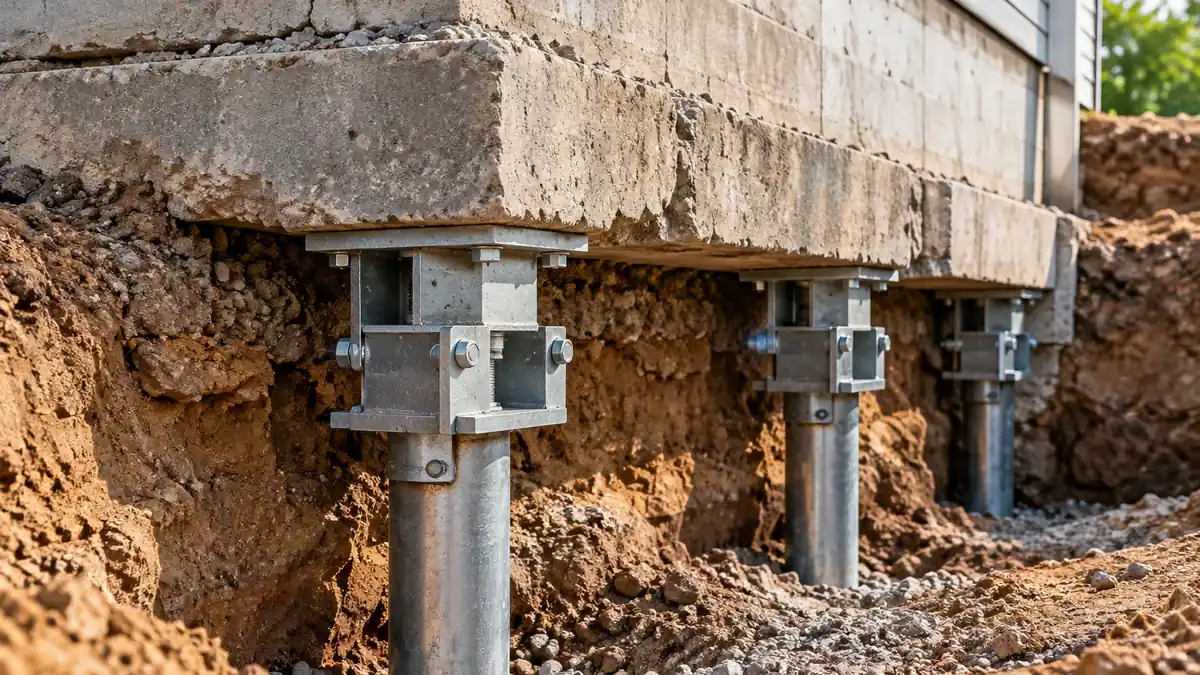
Foundation problems can develop when the soil beneath a building can no longer provide adequate support. Uneven settlement, shifting foundations, and changes in structural loads can affect the stability of residential and commercial properties. In certain cases, foundation underpinning provides a method of strengthening an existing foundation and transferring building loads to more suitable supporting ground.
Underpinning involves reinforcing or extending a foundation so it can carry structural loads under existing site conditions. Depending on the building, soil conditions, and extent of movement, the work may involve steel pier systems, concrete underpinning, or other engineered foundation support methods.
Understanding how these systems work helps property owners recognize when underpinning may be appropriate and what to expect during a professional foundation assessment.
What Is Foundation Underpinning?
Foundation underpinning is a structural repair technique used to strengthen an existing foundation, increase its load carrying capacity, or transfer structural loads to deeper or more suitable soil.
A building’s foundation distributes the weight of the structure into the ground. When the supporting soil settles, loses strength, or moves unevenly, portions of the foundation may experience additional stress.
Underpinning addresses certain types of these problems by establishing a revised load path beneath the existing structure.
Common objectives include:
-
Supporting foundations affected by differential settlement.
-
Transferring building loads to deeper, competent soil layers.
-
Reinforcing foundations when existing support is inadequate.
-
Accommodating structural modifications or additional loads.
-
Supporting existing structures affected by nearby excavation.
Not every foundation problem requires underpinning. The appropriate repair depends on an assessment of the structure and the underlying ground conditions.
Property owners experiencing foundation movement can explore foundation repair services to understand the broader range of available repair approaches.
When Is Foundation Underpinning Necessary?
Underpinning may be considered when the existing foundation cannot adequately support the structure or when changing conditions require a different support system.
1. Uneven Foundation Settlement
Differential settlement occurs when one portion of a building settles more than another. This movement can cause cracking, distortion, and misalignment of structural components.
Potential contributing factors include variations in soil strength, poorly compacted fill, changes in soil moisture, and localized erosion.
When movement is ongoing and the existing supporting ground is inadequate, underpinning may be considered as part of a foundation stabilization plan.
2. Inadequate Soil Bearing Capacity
Soil must have sufficient strength to support the loads imposed by a foundation.
Soft, compressible, or poorly compacted ground can allow settlement under structural loads. Where suitable soil exists at greater depth, engineered underpinning systems may transfer loads beyond the weaker upper layers.
The depth and suitability of the bearing material must be established through appropriate investigation.
3. Structural Modifications and Additional Loads
Building additions, major renovations, and changes in structural use can increase the loads carried by an existing foundation.
If the original foundation was not designed to accommodate these changes, additional support may be necessary.
For larger buildings, deep foundation support systems may be considered where the engineering design calls for support at greater depth.
4. Damage Related to Foundation Movement
Structural damage may occur when a foundation moves beyond what the building can accommodate.
Depending on its cause and severity, the damage might involve foundation walls, floors, framing connections, or other structural components.
A qualified assessment can determine whether the underlying foundation needs reinforcement before other structural repair services are carried out.
5. Excavation Near Existing Foundations
Construction projects involving deep excavation can affect the soil supporting nearby foundations.
Underpinning is sometimes used to support existing structures when excavation changes their original bearing conditions. Such work requires careful engineering design, temporary support where necessary, and controlled construction sequencing.
These applications are recognized in engineering guidance for underpinning design and construction.
Common Foundation Underpinning Methods
Several underpinning techniques are used in foundation engineering. Each method has different installation requirements, load transfer characteristics, and site limitations.
1. Steel Push Piers
Steel push piers, also called resistance piers, are foundation support elements installed beneath an existing foundation.
The system generally involves excavating near the foundation footing, connecting an engineered bracket, and hydraulically advancing steel pier sections into the ground.
The weight of the existing structure provides reaction force during installation. The completed system transfers a portion of the structural load through the brackets and piers into deeper supporting material.
Common applications:
-
Foundations affected by settlement.
-
Structures with adequate weight to provide installation resistance.
-
Locations where suitable supporting ground can be reached.
-
Projects requiring engineered foundation support beneath existing footings.
Push pier installation requires verification of capacity and appropriate load transfer. Their suitability cannot be determined from visible foundation cracks alone.
2. Helical Pier Systems
Helical piers use steel shafts fitted with helical bearing plates. These shafts are mechanically rotated into the ground to the required depth.
Unlike push piers, helical piers do not depend on the weight of the existing structure to advance through the soil.
Installation torque, soil information, pier configuration, and engineering requirements are used to assess the system’s suitability and capacity.
Common applications:
-
Certain residential foundation settlement problems.
-
Structures with relatively light loads.
-
Sites where installation access is restricted.
-
Foundation support projects requiring controlled pier installation.
Helical piers are one option within the broader category of engineered pier systems. The appropriate pier type depends on site conditions and project requirements.
3. Concrete Underpinning
Traditional concrete underpinning involves excavating controlled sections beneath an existing footing and constructing new concrete support beneath the foundation.
This method can extend the foundation to deeper supporting ground or increase its effective bearing area.
Excavation and concrete placement must follow an engineered sequence to avoid undermining adjacent foundation sections.
Common applications:
-
Foundations requiring additional support at a relatively shallow depth.
-
Existing structures where conventional excavation is feasible.
-
Projects where concrete underpinning is more practical than driven piers.
-
Certain building modifications involving existing footings.
The condition of the soil, groundwater, and existing structure can significantly affect whether this method is suitable.
4. Micropile Underpinning
Micropiles are relatively small diameter, drilled structural elements that commonly use steel reinforcement and cement grout.
They can transfer loads to deeper ground and are often considered where space restrictions or difficult ground conditions limit other foundation systems.
Common applications:
-
Commercial and industrial foundation support.
-
Sites with limited installation clearance.
-
Foundation reinforcement beneath existing structures.
-
Projects requiring load transfer to deeper supporting materials.
Micropiles require specialized design and installation. Selection depends on the structural loads, soil and rock conditions, available equipment, and construction constraints.
For commercial projects involving complex structural support requirements, commercial shoring and structural services provide a related area of investigation.
Comparing Foundation Underpinning Methods
| Method | How It Works | Important Consideration |
|---|---|---|
| Steel push piers | Driven using the structure as reaction force | Requires suitable building reaction and bearing conditions |
| Helical piers | Rotated into soil using helical plates | Capacity depends on soil and engineered installation |
| Concrete underpinning | Extends or reinforces existing footings through staged excavation | Requires controlled excavation and construction sequencing |
| Micropiles | Drilled reinforced elements transfer loads to deeper ground | Requires specialized equipment and engineering design |
The correct method depends on the cause of movement, soil properties, structural loads, access, and construction requirements.
How Does the Foundation Underpinning Process Work?
Although installation procedures vary by method, most underpinning projects follow several important stages.
Step 1: Foundation Inspection
The process begins with an inspection of the building and visible signs of foundation movement.
An assessment may document wall cracks, uneven floors, structural distortion, and the condition of existing foundations.
The inspection helps identify the areas of concern and whether additional structural investigation is necessary.
Step 2: Soil and Structural Evaluation
A structural or geotechnical engineer may evaluate soil conditions, foundation loads, existing construction, and movement patterns.
The investigation can help determine whether settlement is ongoing, whether the soil provides sufficient support, and whether underpinning is technically appropriate.
Step 3: Selecting the Underpinning Method
The design professional selects an underpinning approach based on the investigation results.
Important considerations include soil bearing capacity, foundation configuration, required support loads, accessibility, groundwater, and nearby structures.
The selected system must address the structural problem rather than simply treating visible symptoms.
Step 4: Installation of Foundation Support
Installation follows the engineered design and required construction sequence.
Depending on the method, this may involve installing steel piers, drilling micropiles, constructing concrete underpinning, or establishing other support elements.
Temporary support may be necessary during parts of the work.
Step 5: Load Transfer and Final Evaluation
Once the support system is installed, structural loads are transferred to the new foundation elements according to the design.
Where appropriate, an engineered lifting operation may also be considered. However, stabilization and lifting are separate objectives, and returning a structure to its original elevation is not always feasible or advisable.
Final inspections and installation records help document whether the work meets the specified requirements.
Foundation Underpinning vs. Foundation Stabilization
Foundation underpinning and foundation stabilization are closely related, but they do not always describe the same work.
Foundation underpinning involves modifying or reinforcing the foundation’s support system, commonly by transferring loads to additional or deeper structural elements.
Foundation stabilization is a broader objective focused on controlling unwanted foundation movement. Depending on the underlying problem, stabilization may involve underpinning or other structural and ground improvement methods.
For example, a foundation experiencing settlement due to insufficient bearing support may require an underpinning system. Other foundation conditions might be addressed through different stabilization measures.
The type of repair should follow the findings of a professional evaluation.
Residential and Commercial Applications
Residential Foundation Underpinning
Residential applications can involve settling foundations, damaged footings, structural movement, and changes in support conditions.
Homes with foundation settlement may require a combination of investigation, foundation support, and related structural repairs.
Where the problem involves cracked or damaged slab foundations, residential concrete slab repair may be relevant to the overall repair assessment.
Properties with compromised floor support or structural problems beneath the building may also require an evaluation of crawl space repair needs.
Commercial Foundation Underpinning
Commercial buildings can present different engineering challenges because of their structural loads, footing configurations, site constraints, and operational requirements.
Potential underpinning applications include existing building foundations, structural modifications, and support affected by ground movement.
Commercial foundation work may involve deep foundation elements, specialized structural support, and construction procedures developed for the property.
Property managers and building owners can review commercial foundation repair services when assessing foundation damage or structural support concerns.
What Factors Determine the Right Underpinning Method?
There is no single underpinning method suitable for every foundation.
The following factors influence engineering decisions:
-
Soil conditions: Soil strength, compressibility, groundwater, and the depth of suitable bearing material affect the available methods.
-
Structural loads: Building weight and load distribution influence the support capacity required.
-
Type of movement: Differential settlement, ongoing displacement, and other foundation movement require different assessments.
-
Foundation construction: Existing footing dimensions, materials, and structural connections can affect installation.
-
Site accessibility: Restricted spaces, adjacent buildings, and underground utilities may limit equipment access.
-
Construction requirements: Temporary support, excavation safety, permits, and structural monitoring may be necessary.
A qualified structural or geotechnical engineer should determine the appropriate design before underpinning work begins.
Can Underpinning Prevent Future Foundation Settlement?
Properly designed underpinning can help control settlement by establishing additional support or transferring loads to more suitable ground.
However, underpinning does not guarantee that a building will never experience movement again.
Performance depends on the underlying soil conditions, the cause of movement, engineering design, construction quality, and changes affecting the structure after installation.
Problems such as poor drainage, soil erosion, or changing moisture conditions may also require attention.
A responsible foundation repair plan should consider both the structural support system and the conditions contributing to the original problem.
Frequently Asked Questions
What is foundation underpinning?
Foundation underpinning is a structural technique used to strengthen or extend an existing foundation. It may involve concrete support, steel piers, micropiles, or other engineered systems that improve the foundation’s ability to transfer structural loads to the ground.
What are the signs that a foundation may need underpinning?
Possible indicators include recurring foundation cracks, uneven settlement, structural distortion, and changes in floors or wall alignment. These signs do not establish that underpinning is necessary. A professional evaluation is required to identify the cause and appropriate repair.
What is the difference between push piers and helical piers?
Push piers are hydraulically advanced using the building’s weight as reaction force. Helical piers are mechanically rotated into the soil using helical plates. Their suitability depends on structural loads, ground conditions, and engineering requirements.
Can underpinning raise a settled foundation?
Certain underpinning systems may permit controlled lifting of a settled foundation. However, the amount of lifting that can be safely achieved depends on the building’s condition, structural connections, and engineering assessment. Full elevation recovery cannot be guaranteed.
Is underpinning suitable for commercial buildings?
Underpinning can be used for commercial structures where existing foundation support needs to be strengthened or modified. The appropriate method depends on the building’s loads, existing foundation, soil conditions, and project constraints.
How long does foundation underpinning take?
Project duration varies according to the chosen system, number and depth of support elements, accessibility, soil conditions, permitting requirements, and structural complexity. A project specific assessment is needed for a reliable schedule.
Request a Foundation Consultation
Foundation settlement and structural movement require careful investigation before deciding on a repair method. Underpinning may provide additional foundation support in appropriate conditions, but the correct solution depends on the structure and the ground beneath it.
Tar Heel Foundation Solutions provides information about residential and commercial foundation repair services, including foundation stabilization and structural support.
If you are concerned about foundation settlement or structural movement, contact Tar Heel Foundation Solutions to request a consultation and discuss your foundation concerns.