

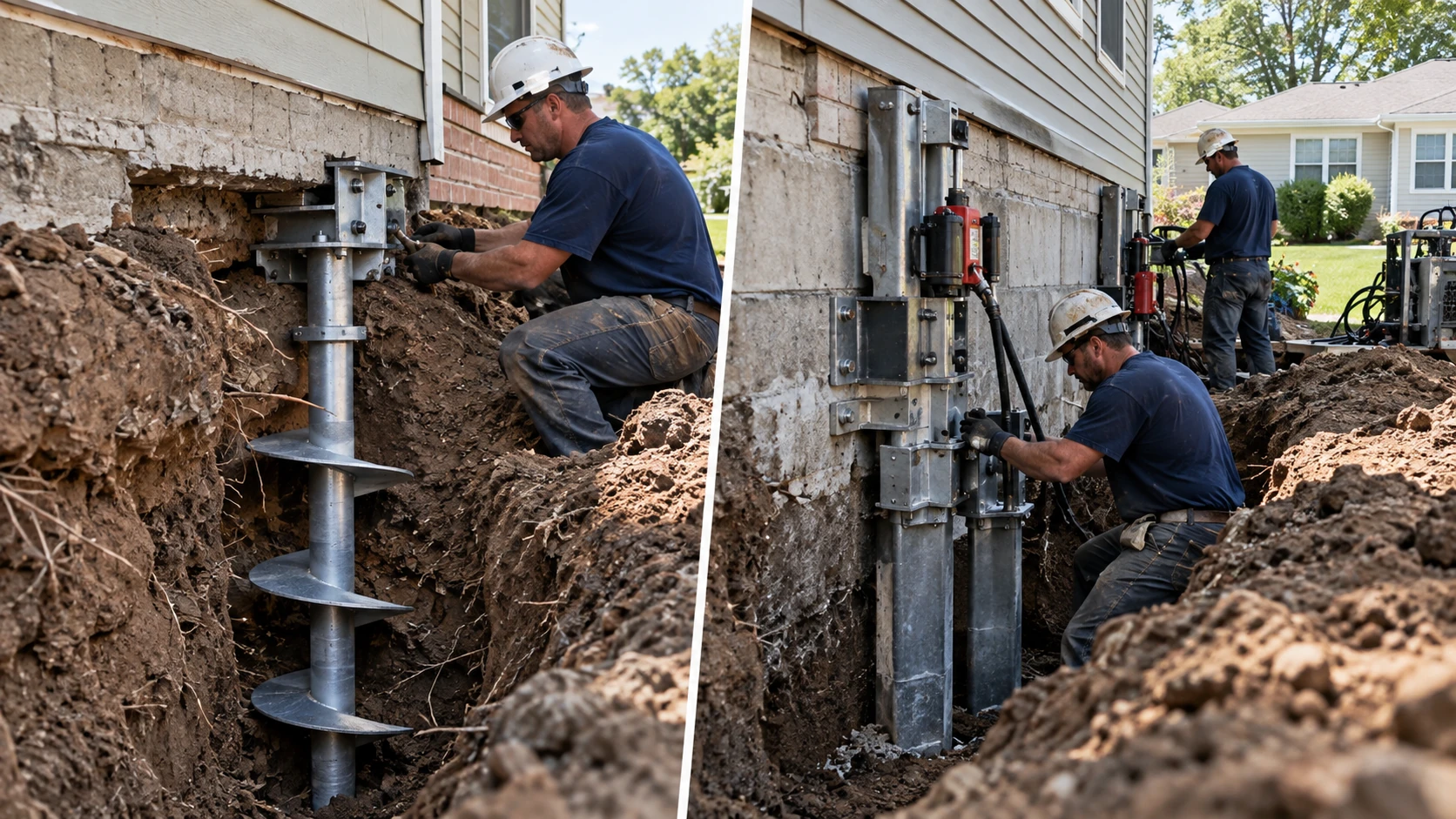
When foundation settlement requires deeper support, two systems commonly enter the conversation: helical piers and push piers. Both can transfer structural loads away from weak or unstable soil, but they reach that goal in different ways.
The right choice in a helical piers vs push piers comparison depends on the structure, soil conditions, available access, load requirements, and the type of movement affecting the foundation. Neither system is automatically better for every property.
A professional foundation repair evaluation is usually the starting point because the visible symptoms alone do not tell you which pier system, if any, should be used.
Quick Answer: What Is the Main Difference Between Helical Piers and Push Piers?
Helical piers are steel shafts with one or more helix-shaped plates that are rotated into the ground. Push piers are steel sections that are hydraulically driven into the soil using the existing structure as resistance.
That difference affects where each system may be practical.
Helical piers can be installed without relying on the weight of the building to push them downward. This can make them useful for some lighter structures, certain access conditions, and applications beyond existing foundation repair.
Push piers rely on resistance from the structure during installation. They are commonly considered when an existing building has sufficient weight and the goal is to transfer foundation loads to stronger soil or another suitable bearing layer below.
For either system, the actual design should be based on the property and engineering requirements rather than the name of the pier. ICC-ES documentation for helical foundation systems specifically calls for site-specific design considerations, including loads, soil conditions, embedment, and expected foundation movement.
If settlement is already occurring, foundation stabilization may involve one of several repair methods depending on what the evaluation finds.
How Helical Piers Support a Foundation
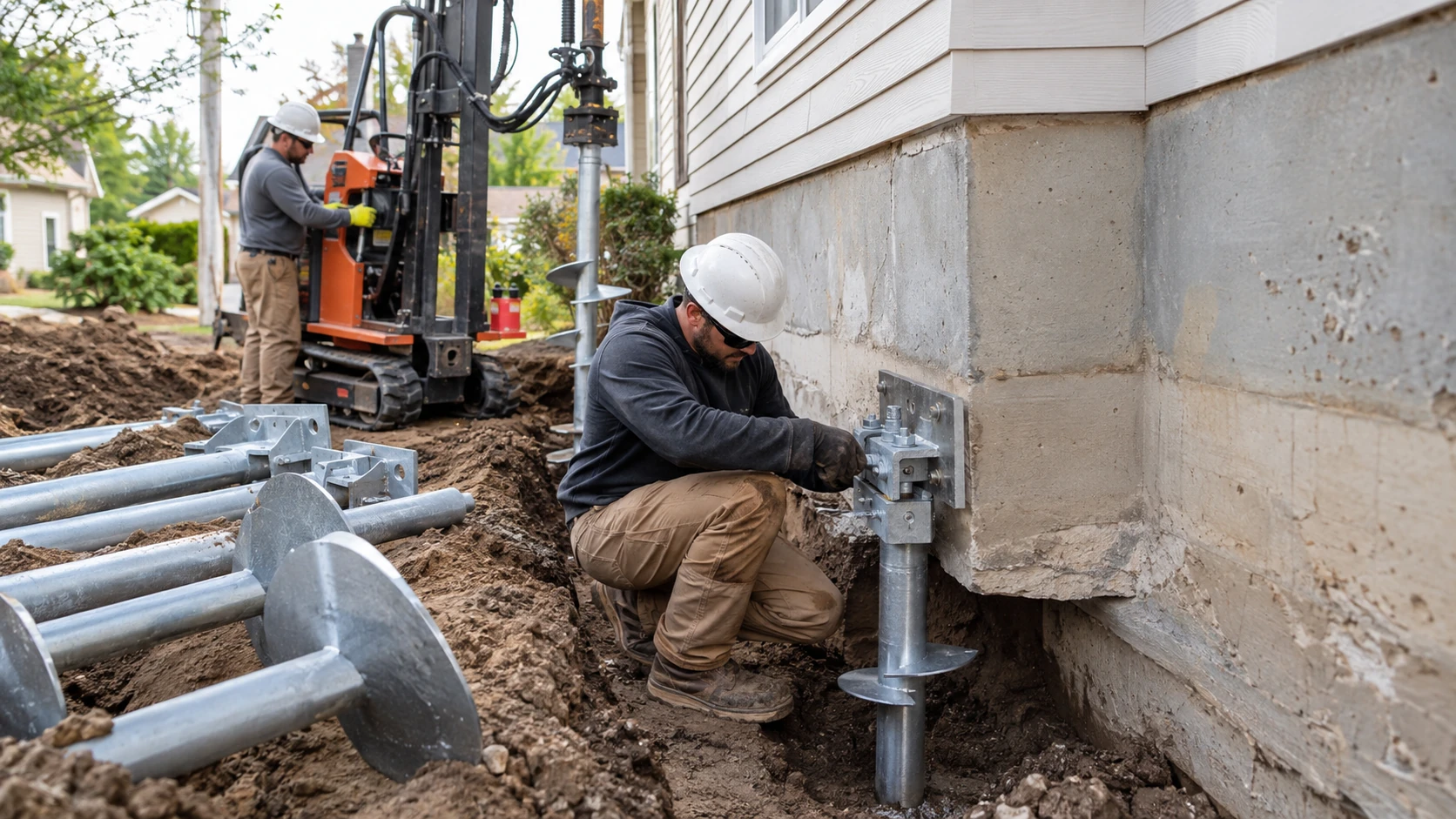
A helical pier, also called a helical pile or screw pile, has steel helix plates attached to a shaft. Installation equipment rotates the shaft into the ground rather than forcing it straight downward.
The pier can be extended until the required depth and soil resistance criteria are reached. A bracket then connects the installed pier to the foundation when the system is being used for underpinning.
ICC-ES describes helical pile systems as being screwed into the ground using torsion until the required depth and suitable bearing conditions are reached. Depending on the system and design, helical foundations can be used for existing foundation underpinning as well as new construction applications.
Installation Torque Provides Useful Field Information
One useful characteristic of helical piles is that installation torque can be used as part of the process for estimating or confirming pile capacity. As the pile advances through the soil, the resistance to rotation changes.
That information does not replace proper engineering or an understanding of subsurface conditions. Technical guidance notes that soil properties, pile configuration, shaft dimensions, and other factors can influence the relationship between torque and capacity.
Helical Piers Do Not Depend on Building Weight for Installation
Because installation is performed by applying rotational force to the pier, a heavy existing structure is not required to provide the reaction force needed to advance the pier.
That distinction becomes important when dealing with a relatively light structure or when a deep foundation system is being considered before a building has been constructed.
How Push Piers Work Beneath an Existing Foundation
Push piers, sometimes called resistance piers, use a different installation method.
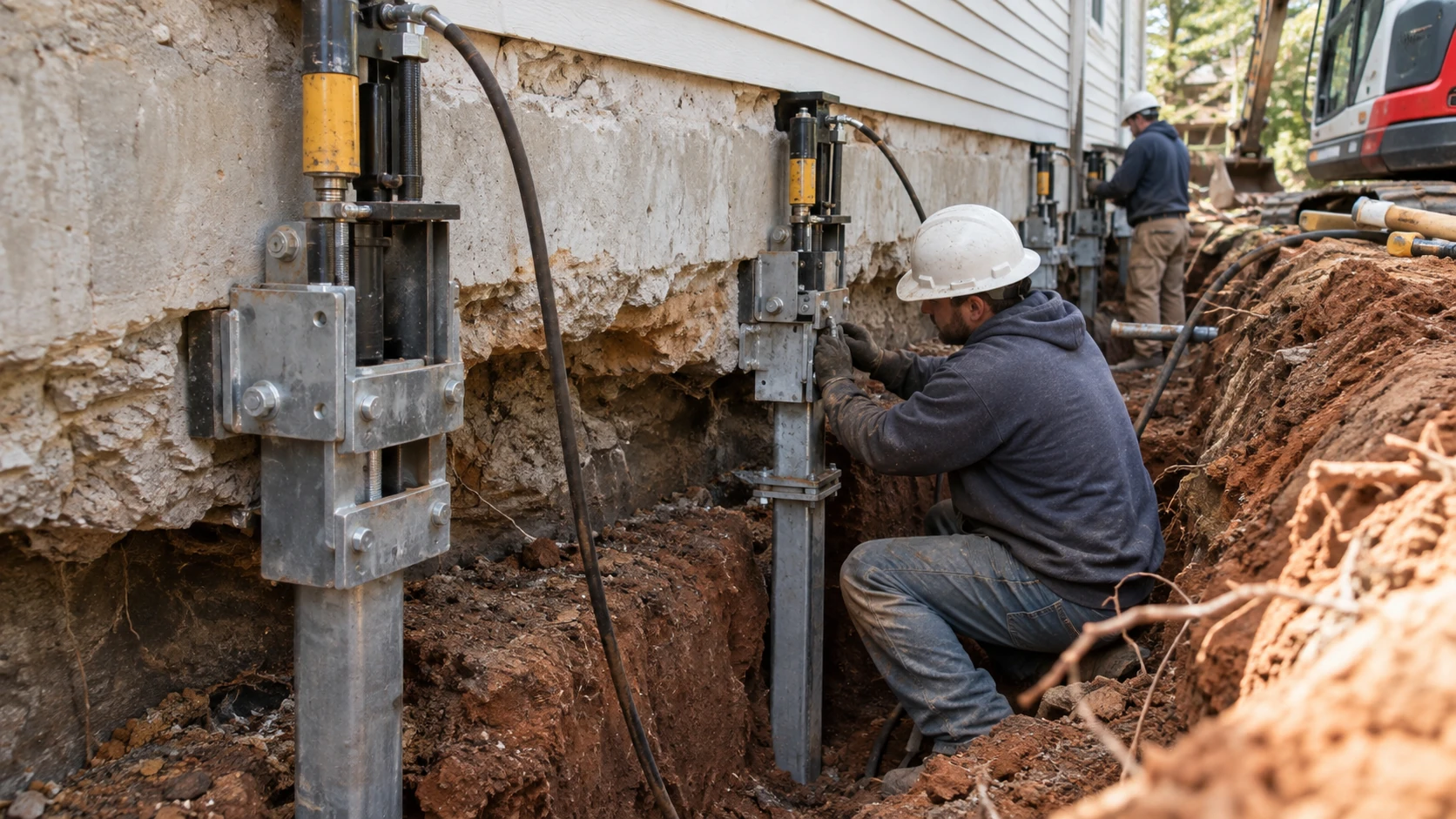
A steel bracket is installed at the existing foundation. Sections of steel pier are then hydraulically driven through the bracket and into the soil.
The structure provides resistance while the hydraulic equipment advances the pier. Sections continue to be added until the installation reaches the specified resistance or suitable load-bearing conditions.
Technical descriptions of push pier systems explain that the existing structure and contributing soil load provide the reaction force used during hydraulic installation. Once the required conditions are reached, structural loads can be transferred through the bracket and pier into the supporting soil below.
This makes push piers particularly associated with underpinning existing structures rather than supporting a foundation that has not yet been built.
Helical Piers vs Push Piers Side by Side
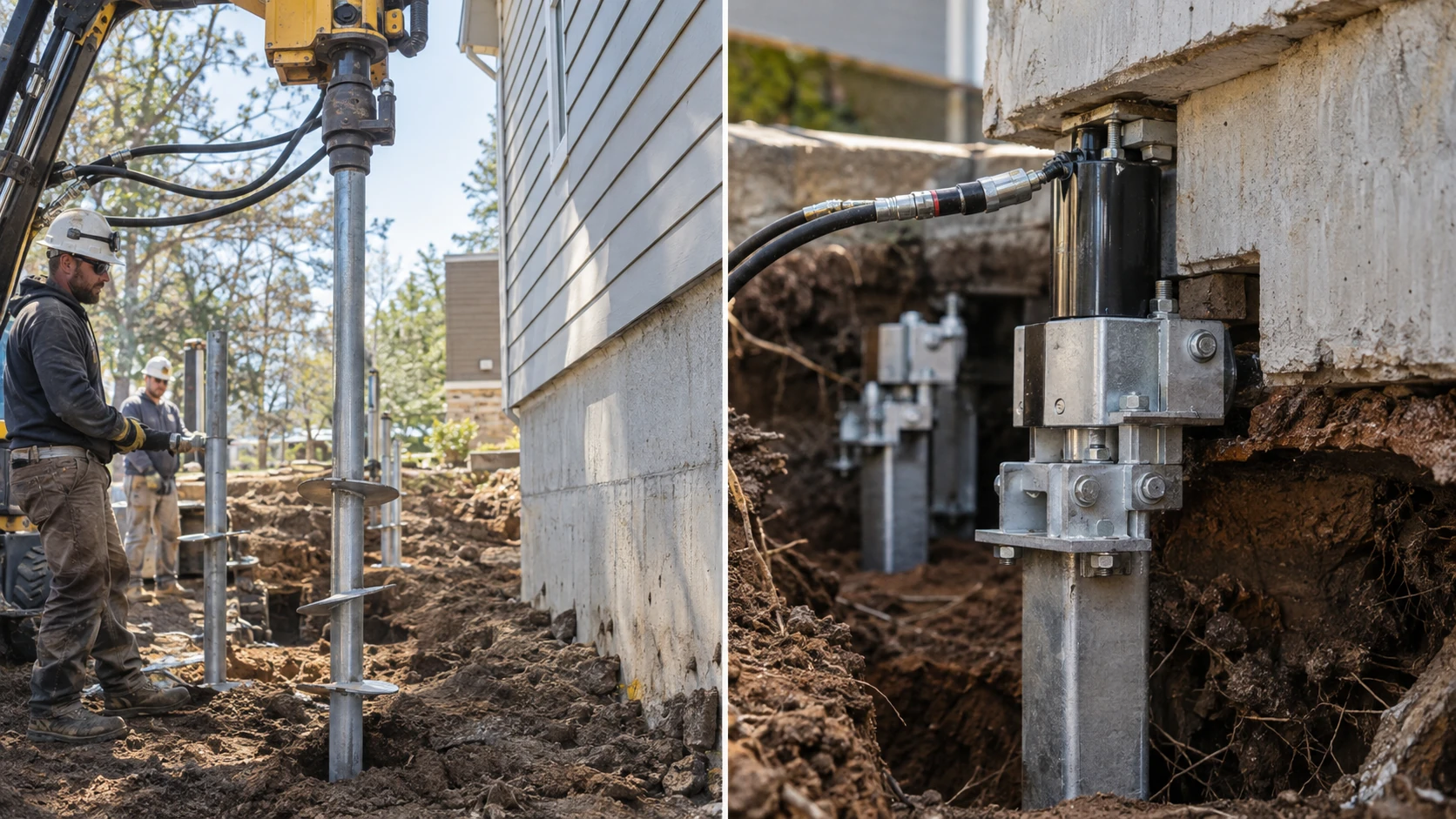
The differences become easier to understand when the systems are compared according to how they function.
| Factor | Helical Piers | Push Piers |
|---|---|---|
| Installation method | Rotated into soil using torque | Hydraulically driven into soil |
| Uses building weight as installation resistance | No | Yes |
| Common application | Existing foundation support and certain new construction applications | Underpinning existing structures |
| Field installation indicator | Installation torque, depth, soil information, and design requirements | Hydraulic pressure, installation resistance, depth, and design requirements |
| Suitable for light structures | May be considered because installation does not depend on structure weight | Structure must provide adequate reaction for installation |
| Compression support | Yes, when designed for the application | Common application |
| Tension or uplift applications | Possible with appropriately designed systems | Typically not the primary purpose of retrofit push pier systems |
| Foundation lifting | May be possible in some repair designs | May be possible in some repair designs |
| Final selection | Depends on soil, loads, access, structure, and engineering | Depends on soil, loads, access, structure, and engineering |
The important distinction is not simply which pier can go deeper. Either system may require substantial depth depending on the soil profile and project requirements.
Depth by itself does not determine which foundation pier system is appropriate.
Make Sure Piers Are Actually the Right Repair
Cracks, uneven floors, sticking doors, and visible settlement can suggest foundation movement, but they do not automatically mean a property needs piers.
The cause has to be identified first.
For example, a sunken driveway or isolated walkway may involve a concrete settlement issue rather than a structural foundation problem. In those situations, concrete lifting and leveling may be more relevant than underpinning the building.
A damaged structural slab may require a different approach as well. The condition should be assessed before assuming deep foundation support is necessary. Tar Heel’s concrete slab repair services address slab-related problems separately from other foundation concerns.
Wall movement is another example. A bowing or laterally moving foundation wall presents a different load condition than vertical settlement. Depending on the cause, solutions such as earth anchor systems may be considered instead of vertical foundation piers.
Correctly identifying the problem prevents the pier comparison from becoming a choice between two solutions that may not address the actual cause.
Soil and Bearing Conditions Can Change the Decision
A pier system works by transferring loads through unsuitable or unstable material to soil capable of providing the required support.
That sounds straightforward, but underground conditions can vary considerably across the same property.
One side of a structure may encounter competent material at a different elevation than another. Fill soil, soft layers, dense material, groundwater conditions, or buried obstructions can also affect installation and design.
Helical piles are advanced according to specified depth, torque, and design requirements. Push piers are advanced hydraulically until the required installation criteria are reached. Neither method should be selected solely by assuming that one particular depth will work everywhere.
Current ICC-ES evaluation requirements for helical systems emphasize site-specific geotechnical information, soil suitability, bearing parameters, loads, and settlement considerations when designing the system.
This is why two neighboring homes with similar-looking foundation cracks can require different repair plans.
The Weight and Load Path of the Structure Matter
The weight of the existing building is one of the most meaningful differences between these foundation pier systems.
Push piers need the structure to provide resistance during hydraulic driving. If the structure cannot provide enough reaction force for the required installation, another system may need to be considered.
Helical piers do not have the same installation dependency because the shaft is rotated into the soil.
That does not mean helical piers should automatically be chosen for every lighter building. The structural loads still have to be calculated, the soil still has to support the proposed system, and the connection between the pier and foundation must be suitable.
Likewise, a heavier building does not automatically require push piers.
The whole load path matters, from the building through the footing or foundation, into the bracket, down the pier, and finally into the supporting soil.
If settlement has already affected structural components, a broader structural repair assessment may also be necessary.
Access, Installation Conditions, and Cost Factors
Homeowners often ask which system costs less. There is no reliable answer without evaluating the project.
Pier type is only one part of the cost.
The number of support locations, installation depth, excavation requirements, access around the foundation, structural repairs, soil conditions, engineering needs, and restoration work can all affect the scope.
A property with open access around the affected wall may present a very different installation situation from a home where landscaping, decks, utilities, narrow side yards, or other structures restrict equipment movement.
Obstructions underground can matter too.
For helical piers, unexpected subsurface material may affect how easily the helix assemblies advance. With push piers, variations in soil resistance can change where installation criteria are reached.
Because of these variables, comparing a generic “price per pier” without comparing the full repair scope can be misleading.
Homeowners considering either method can start by reviewing the broader residential foundation services that may be involved in correcting the underlying problem.
Stabilization and Foundation Lifting Are Not the Same Goal
A common misunderstanding is that installing piers automatically returns a settled foundation to its original position.
The first objective is often stabilization.
Stabilization is intended to transfer the affected foundation load to deeper support and reduce the risk of continued movement associated with the failed bearing conditions.
Lifting is a separate decision.
Depending on the structure, condition of the foundation, extent of settlement, connections to other building components, and engineering requirements, controlled lifting may sometimes be attempted. Technical documentation for both helical and push pier systems recognizes repair configurations capable of supporting or lifting existing foundations, but lifting has to remain within the limits of the structure and repair design.
Trying to force a structure back to a particular elevation can create additional stress in walls, framing, plumbing, finishes, and other components.
A realistic repair plan should therefore explain whether the goal is stabilization, partial recovery, or another defined outcome rather than promising that every crack, floor slope, or cosmetic issue will disappear.
When Helical Piers or Push Piers May Be a Better Fit
There is no universal winner in the helical piers vs push piers comparison. Each method becomes more practical under different conditions.
Situations Where Helical Piers May Be Considered
Helical piers may make sense when:
- The structure cannot provide enough reaction weight for push pier installation.
- The project involves certain new construction or pre-construction foundation support needs.
- Installation torque will be used as part of field verification.
- The engineered foundation system needs to address compression and, where designed, tension or uplift loads.
- Site conditions and access support rotary installation.
The final design still depends on soil information, structural loads, pile configuration, and the specific system being installed.
Situations Where Push Piers May Be Considered
Push piers may be appropriate when:
- An existing structure has experienced foundation settlement.
- The building provides sufficient reaction force for hydraulic installation.
- The repair requires transferring existing structural loads through deep foundation support.
- The pier can be advanced until the required installation resistance or bearing conditions are achieved.
- Access to the existing footing allows installation of the required brackets.
IAPMO’s current evaluation report for specific push pier systems recognizes them as support foundation systems subject to engineering, installation, soil, and structural requirements.
Rather than starting with “Which pier is stronger?” it is more useful to ask, “Which installation method and load-transfer system fits this structure and these soil conditions?”
What a Foundation Evaluation Should Confirm Before Choosing a Pier
A useful evaluation should do more than identify cracks and recommend a product.
What Is Actually Moving?
The first question is whether the observed problem represents foundation settlement, slab movement, wall displacement, structural deterioration, or another condition.
Different movement patterns require different solutions.
What Conditions Exist Beneath the Foundation?
Soil conditions influence how deep foundation systems are designed and installed. Available geotechnical information, local soil knowledge, installation measurements, and project-specific investigation can all contribute to the decision.
A pier should not be selected simply because it was used successfully on another property.
Can the Existing Foundation Carry the Repair Loads?
Brackets transfer loads between the structure and the pier. The condition and configuration of the existing foundation therefore matter.
Cracked, deteriorated, undersized, or unusual structural components may require additional evaluation before loads are transferred.
What Is the Intended Repair Outcome?
The contractor and property owner should understand whether the proposed work is intended to:
- Stabilize future movement
- Support a settling portion of the structure
- Attempt controlled lifting
- Address associated structural damage
- Correct another foundation-related condition
A clearly defined goal makes competing repair proposals much easier to compare.
Tar Heel Foundation Solutions provides several foundation and structural services because settlement problems do not always have the same cause or repair requirements.
Planning Your Next Step
Helical piers and push piers are both established foundation support methods, but their installation mechanics are fundamentally different.
Helical piers are rotated into the ground and do not require the weight of the existing building to advance the system. Push piers are hydraulically driven using the structure as reaction force. From there, soil conditions, structural loads, access, foundation condition, and the intended repair outcome determine which approach may be suitable.
The most useful comparison is therefore not about choosing the system with the better reputation. It is about identifying the cause of settlement and determining which foundation support method fits the actual property.
If you’re seeing foundation settlement or structural movement, schedule an evaluation before deciding between pier systems.